CineWeaver
Training-Free Reference-Controllable Multi-Shot Long Video Generation for Cinematic Storytelling

A unified inference-time framework that enables clear shot transitions, shot-level reference control, and long-form consistency in pretrained video diffusion models without retraining.

Key features

Training-free multi-shot

Break temporal continuity at inference time.

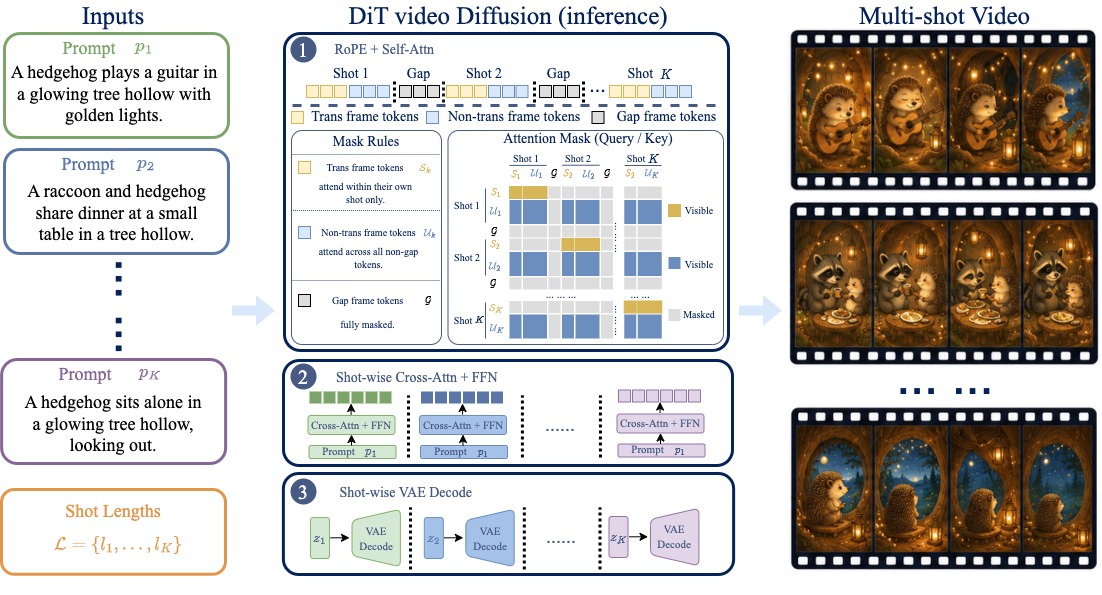
CineWeaver inserts gap frames, uses transition-aware masked self-attention, adopts shot-wise conditioning, and performs isolated VAE decoding to produce explicit shot boundaries without additional training.

Reference control

Route visual references to designated shots.

Shot-wise reference routing allows each shot to inherit specific subjects, backgrounds, or layouts while preserving cross-shot identity consistency and avoiding prompt leakage between scenes.

Long-form consistency

Anchor memory keeps global appearance stable.

A compact set of anchor tokens propagates shared lighting, grading, and style cues across independently generated segments, enabling minute-scale cinematic storytelling with consistent global appearance.

Abstract

Cinematic video generation is challenging for text-to-video diffusion models due to concurrent requirements on multi-shot generation, fine-grained controllability over characters and scenes, and long-form generation across extended temporal horizons. Existing methods rely on customization and retraining to separately address specific requirements, and cannot simultaneously fulfill all the requirements with a unified framework. In this paper, we shed light on the training-free paradigm with the key insight that the difficulty of multi-shot generation arises from a structural bias toward temporal continuity in pretrained video diffusion models, and consequently, propose a unified framework named CineWeaver to achieve reference-controllable multi-shot long-video generation without retraining. We manipulate positional encoding and attention patterns to break temporal continuity during inference to enable clear shot transitions using pretrained video diffusion models. Furthermore, we extend the proposed framework with a shot-routed reference conditioning mechanism for per-shot fine-grained controllability, and develop an anchor memory mechanism to allow long-form generation with consistent global appearance cues. To our best knowledge, CineWeaver is the first unified framework to simultaneously enable long-form, reference-controllable, and multi-shot video generation in a training-free fashion. Experimental results demonstrate that CineWeaver produces high-quality cinematic videos of long durations with consistent identities, stable global appearance, and clear shot transitions.
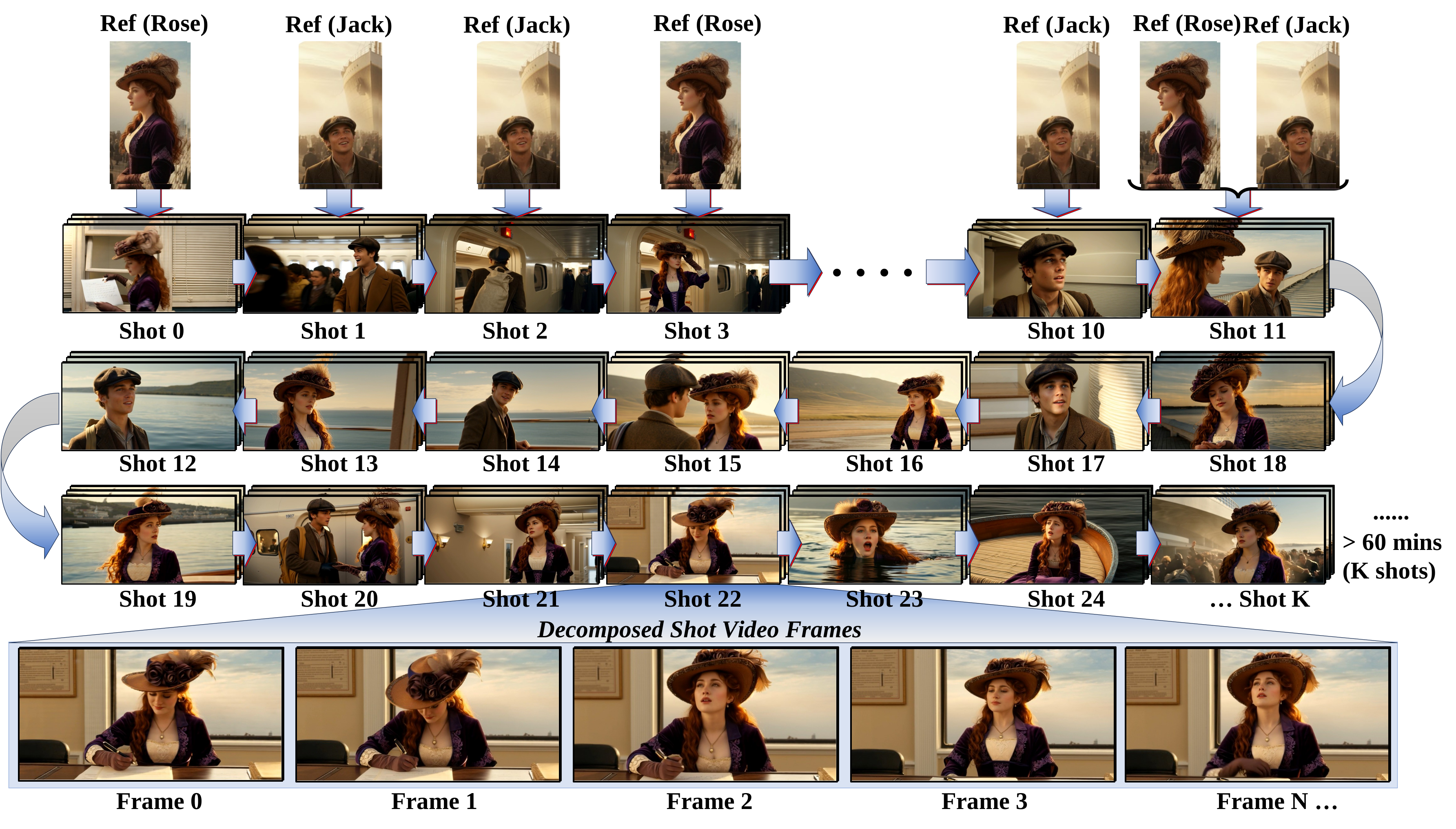
CineWeaver teaser showing Titanic-style multi-shot video generation with reference images and shot-level descriptions.
Teaser. CineWeaver generates a multi-shot Titanic-style video conditioned on reference images of Jack and Rose and shot-level descriptions.

Method overview

Pipeline overview of CineWeaver with gap frames, masked self-attention, shot-wise conditioning, and isolated VAE decoding.
Figure 1. CineWeaver breaks temporal continuity with gap frames and transition frames, then adds shot-wise conditioning and isolated decoding to produce stable multi-shot generation without retraining.
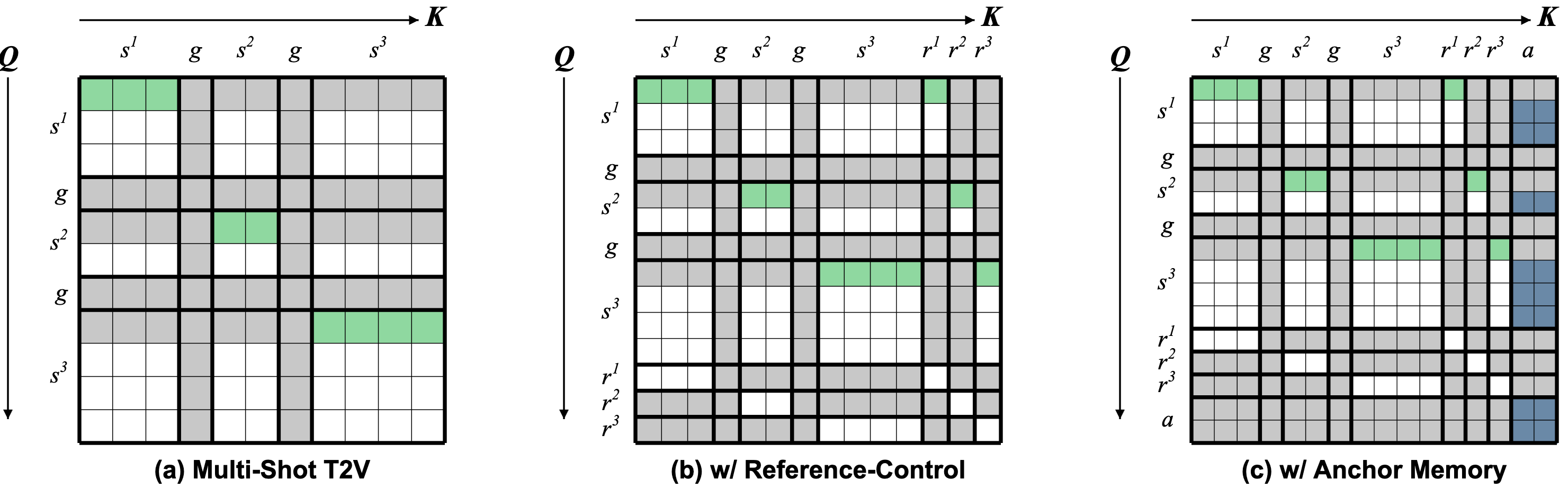
Attention masks used for multi-shot generation, reference routing, and long-video anchor memory.
Figure 2. Attention masks for multi-shot text-to-video, reference-controllable generation, and long-form anchor memory extension.

CineWeaver treats multi-shot composition as an inference-time structural problem rather than a retraining problem. The full framework can be read in three simple pieces:

1. Multi-shot structure

Break continuity where shot cuts should happen.

Gap frames, transition-frame masking, shot-wise conditioning, and isolated VAE decoding suppress the single-shot continuity bias of pretrained video diffusion models.

2. Reference routing

Send each reference only to its designated shot.

Reference tokens are routed according to shot structure, enabling explicit per-shot control over subjects, backgrounds, and scene appearance without cross-shot prompt interference.

3. Anchor memory

Propagate global style across long generated segments.

A compact anchor memory carries stable appearance cues such as lighting, grading, and overall style, allowing long-form cinematic generation with stronger cross-segment coherence.

Citation

@article{huang2026cineweaver,
  title   = {CineWeaver: Training-Free Reference-Controllable Multi-Shot Long Video Generation for Cinematic Storytelling},
  author  = {Huang, Yuyang and Chen, Yabo and Dai, Wenrui and Zheng, Ziyang and Huang, Haibin and Zhang, Chi and Zou, Junni and Xiong, Hongkai and Li, Xuelong},
  journal = {International Journal of Computer Vision},
  year    = {2026}
}

CineWeaver uses Wan2.1-14B for training-free multi-shot generation and Phantom-14B for reference-controllable and long-form extensions, while keeping all backbone parameters frozen during inference.

The page layout is adapted to match the structure and interaction style of the SANA-WM project page.